Building a Kite Aerial Photography Rig is as much about trial and error
and
learning from mistakes as anything else, here are some of my thoughts:
|
So, after a season flying with Rig02, what have I learned? By February 2003 the rig worked enough to get out in the field and take pictures, but what needed improved once the real testing started - taking pictures! Desensing
Make sure you have a robust and strong signal for the SERVOS at all times,
this will put less strain on the rig, use less battery power, and make life
easier. Fiddly bits
Getting the rig ready for flight should involve as little
"construction" as possible, time spent here makes all the difference
in the field, and also should prevent little bits being left behind when you
finish for the day. Weight
I can't claim originality for this statement that I read somewhere on the web,
but it's one of those sentiments you read and then it remains with you. In Scotland we have
a reputation for being careful with money, so I feel I have the authority to use
the saying - "Look after the
pennies and the pounds will look after themselves". In imperial
measurements: Getting your kit to the field
Be ultra organised, follow a routine, make sure the ground equipment, as well as the kite and Rig are "airworthy". Did you notice the A4 sheet inside the case as the lid opened? A couple of laminated sheets of pictures I've taken and some business cards with my url - always have them handy for the bystander who is brave enough to ask what you're doing! One last point, if flying alone I find it difficult to tidy the case away once the rig is airborn. It is a useful marker for when I return from my walk with the kite as to where the kite stake was left! I have also found that the electronic key-fob to unlock the car doesn't work once the SERVO transmitter is switched on so I can't lock it in the car anyway :-). This is all very well if there is no-one around, however the above case has been reported to the police by a "helpful" passer-by who thought it looked suspicious. Plan your Photographs
Plan your photograph. Be aware of what you want before you launch the kite. Reconnoiter the site, and wait for the right wind and the right weather. Have locations for testing and locations for photography. There's more on Photographic Technique in a separate document. |
 The main page for
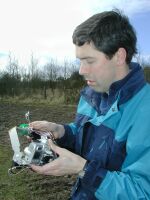 Setting the rig up on a bench or table indoors is easy - doing exactly the same
thing on a windy kite field is a nightmare. Add an audience, a dog, or anything
else and you have a problem. Even simple tasks like adding a glass fiber support
for the aerial, or adjusting an elastic band to hold batteries, become
unmanageable in the field.
Setting the rig up on a bench or table indoors is easy - doing exactly the same
thing on a windy kite field is a nightmare. Add an audience, a dog, or anything
else and you have a problem. Even simple tasks like adding a glass fiber support
for the aerial, or adjusting an elastic band to hold batteries, become
unmanageable in the field.
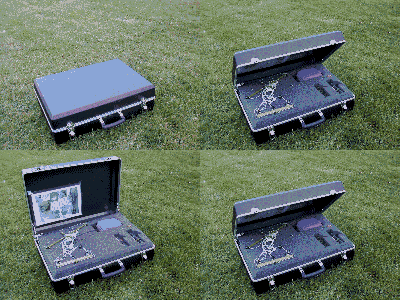 A variation on having less fiddly bits. I acquired a large camera case with foam
inserts. I then cut out slots for the rig, transmitter, batteries and stuff. I
was really pleased with myself. However when I tried to use the case in the
field the material was neatly packed but not in the order I needed it. Add a
15mph wind and I was chasing stuff over the field.
A variation on having less fiddly bits. I acquired a large camera case with foam
inserts. I then cut out slots for the rig, transmitter, batteries and stuff. I
was really pleased with myself. However when I tried to use the case in the
field the material was neatly packed but not in the order I needed it. Add a
15mph wind and I was chasing stuff over the field.