|
I've been interested in photography for longer than I'd like to say, mainly
landscape of Scotland's mountains when I was younger, and I've come back to
landscape with KAP.
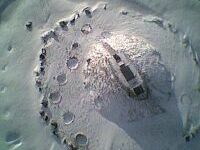 This page consists of a number of KAP and landscape images illustrating
various photographic points. These look like a set of rules, but at the outset
I'd like to place these rules in context. Photography is an art, with some craft.
For me the rules set a framework of what tends to work and what doesn't. They
are not there to be blindly followed, in fact breaking them can make a picture.
However over the years I have found that understanding the rules, helps get a
better picture. The idea is to get to the stage that you do some of these things
instinctively, and that's when you start to move away from the rules and become
creative! This page consists of a number of KAP and landscape images illustrating
various photographic points. These look like a set of rules, but at the outset
I'd like to place these rules in context. Photography is an art, with some craft.
For me the rules set a framework of what tends to work and what doesn't. They
are not there to be blindly followed, in fact breaking them can make a picture.
However over the years I have found that understanding the rules, helps get a
better picture. The idea is to get to the stage that you do some of these things
instinctively, and that's when you start to move away from the rules and become
creative!
One final point. Most photographic books or web-pages I read assume you have
a stable tripod for landscape work. In a similar way to the still
life practitioners who spend a long time selecting the scene and composing the picture.
Even with the most stable suspension system in the world this just isn't going
to happen with KAP. So my premis is that when you compose the picture you do the
best you can then shoot off lots of digital images. Once back on the computer
you can use your instinct to select, crop, edit and stitch an image. Purists
will argue that this post-processing on the computer isn't in the spirit of
photography, but I see it all as part of the art, craft, and fun of KAP.
Why bother?
KAP isn't easy, as well as all the normal photographic considerations, you
need a rig, a kite, the right wind, a kite launch site, and a greater consideration for the
safety of others - why bother?
I believe that low altitude photography can give a unique perspective on the
world. In order to demonstrate this consider the following four images of
Warkworth Castle (English Heritage) in Northumberland:
 |
From the Car Park, Warkworth Castle maintains a formidable entrance across the dry-moat.
This is the wide-angled view that every visitor gets of the castle from the
south, with a limited view of what may lie inside.
© James Gentles 2003
|
 |
From the kite, some of the castles secrets are revealed.
The moat and walls still guard the interior, but the layout of the various buildings within
becomes more obvious.
Strong oblique sunshine accentuates the ramparts, and the earth mound
the castle sits on. This makes the castle stand-out of the
foreground.
© James Gentles 2003
|
 |
From the additional height afforded by an airplane a further dimension is seen, with the
castle's prominent defensive position on a loop on the River Coquet.
The village of Warkworth can now be seen nestling behind,
and filling the loop in the river, although the castle isn't so
prominent in this image, as it was at a lower altitude.
Thanks to Airimages,
Northumberland, for allowing the
use of this view.
© airimages at www.airimages.co.uk
|
 |
Finally this shot has a different appeal, more of a living
map than a photograph.
The strategic position of the castle is demonstrated, however much of
the impact of it's dramatic location is lost as all relief disappears due
to the height of the camera above ground.
Additionally, unwanted elements in the picture (like the two bridges
above the town) become a distraction.
Cant
see image? click here
© Getmapping served from www.multimap.com
|
My conclusion is that KAP, aerial and satellite images can all play to their
strengths, depending on the subject matter. Each one has it's own technical
difficulties, however there are rewards for those who overcome them. Another
important lesson is that you don't need 1000' of line to take a good picture, in
fact I would argue that since KAP fills the low-altitude aerial photography
niche, you should stick to below 500' (local legal restrictions permitting), and
play to the strength!
There is however no excuse for poor photographs, so both a technical and
artistic challenge requires to be overcome...
Architecture, Art, and Amnesia
There are three main reasons for taking pictures. To illustrate, take these
three very different images of the Falkirk
Wheel:
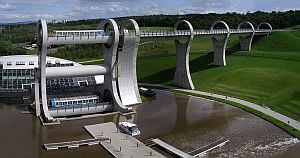 Architecture:
This is a wide angle shot, and the height that KAP allows adds to the effect.
The whole object is in shot and with only a little explanation the concept of
the boat-lift can be understood, even if you have never been there. Architecture:
This is a wide angle shot, and the height that KAP allows adds to the effect.
The whole object is in shot and with only a little explanation the concept of
the boat-lift can be understood, even if you have never been there.
The picture tells a story to a large audience, and is self contained. I've
used an object for my example, but an image of a runner winning a race by a
whisker also meets the criteria.
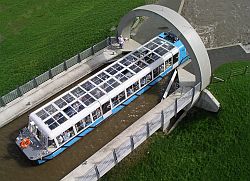 Art: This style
of shot works on two levels. For people who have already seen the Wheel, there
will be a pleasure and resonance in the unusual barge, and the semi-circular
arch, reminding them of the whole structure. If you haven't ever seen the whole
structure then the angles and curves give the shot an abstract feel. Again KAP
lends itself to this style of picture, and of course there is no limit to
how abstract you want to be! I only chose this image to maintain the idea that
the one subject can be used for all three genres. Art: This style
of shot works on two levels. For people who have already seen the Wheel, there
will be a pleasure and resonance in the unusual barge, and the semi-circular
arch, reminding them of the whole structure. If you haven't ever seen the whole
structure then the angles and curves give the shot an abstract feel. Again KAP
lends itself to this style of picture, and of course there is no limit to
how abstract you want to be! I only chose this image to maintain the idea that
the one subject can be used for all three genres.
This picture has an abstract pleasure, with specific resonance for some
people. The unusual angles obtained in KAP, including the 'straight down' shot
also lends itself to this genre.
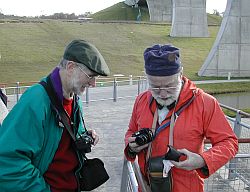 Amnesia: More of
these photographs are taken than any other. Whilst they can communicate intense
memory recollection amongst the people who were there when the picture was taken
they generally mean nothing to everyone else. There is little point explaining
why this picture means so much to me, the common thread is that it was taken at
The Falkirk Wheel. Amnesia: More of
these photographs are taken than any other. Whilst they can communicate intense
memory recollection amongst the people who were there when the picture was taken
they generally mean nothing to everyone else. There is little point explaining
why this picture means so much to me, the common thread is that it was taken at
The Falkirk Wheel.
This picture tells a story, but to a very small audience, generally they are
spontaneous, and because of the large set-up time with KAP, it doesn't lend
itself to "snapshots".

Of course there is nothing wrong with the last category, photographs should be
about memories as much as about art. In fact combining elements of all the above
classifications will allow your images to have layers of understanding, seen in
different ways by different people.
The most common opportunity for combination
is the "here I am in front of the Falkirk Wheel" shot, but
there are many creative ways to combine the big picture, abstract / art, with
individual memories.
Places and Patience
So, what do I take pictures of? You may have started KAP with a
view to taking particular pictures, however they have to meet photogenic as well
as practical rules.
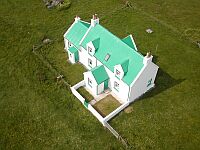 What
looks good from the air is something you have to learn, sometimes the simplest
objects can look stunning, and stunning objects can look boring. Look at other
people's galleries and translate them into ideas in your locality. One
combination I find works is the mix of impossible angle, simple subject, and
strong colour, yes the roof really is that shade of green! You will spend
several hours on a shoot, so pick your subjects carefully! What
looks good from the air is something you have to learn, sometimes the simplest
objects can look stunning, and stunning objects can look boring. Look at other
people's galleries and translate them into ideas in your locality. One
combination I find works is the mix of impossible angle, simple subject, and
strong colour, yes the roof really is that shade of green! You will spend
several hours on a shoot, so pick your subjects carefully!
This is when the practicalities get in the way. Reconnoiter the site before
hand. Where will you launch the kite? What wind directions are favourable? Are
there cables or power lines ANYWHERE
nearby? What is the best kite to use for high angle or long reach?
Be patient! Wait for the right wind and weather, even the right time of day
for sun angles, before returning for the shoot. I keep a list of potential
sites, with details of launch sites, wind conditions etc.
Frame and Line
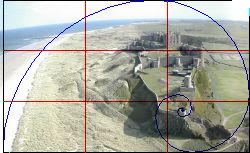 There are a
number of basic rules about the framing of a picture. Most basic is the Golden
Ratio (1:1.618), which is supposed to be the most pleasing to view. Generally
landscape format is considered more soothing and portrait more tense. There are a
number of basic rules about the framing of a picture. Most basic is the Golden
Ratio (1:1.618), which is supposed to be the most pleasing to view. Generally
landscape format is considered more soothing and portrait more tense.
The Rule of Thirds highlights where areas of interest or lines should be.
Interest should lie on these lines, or be centered around the 4 intersections,
or hot-spots. It is considered good practice to have the horizon, for example,
on one of these lines.
Also on the picture shown is the Golden Spiral. Rather than the static thirds
this spiral traces out a dynamic path for the eye to move through the picture,
finishing on one of the hot-spots. Does your eye get led into the picture along
the spiral? In this case the line between the sand and dunes forms the line, but
more conventionally it could be a road, track, fence or wall.
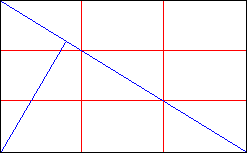 For images with less strong horizontal and
verticals you could try
fitting the image to the blue lines on the right. Note the right angle of the
two blue lines, and how it is close to a hot-spot on the Rule of Thirds which is
also included on the diagram. For images with less strong horizontal and
verticals you could try
fitting the image to the blue lines on the right. Note the right angle of the
two blue lines, and how it is close to a hot-spot on the Rule of Thirds which is
also included on the diagram.
Remember these templates can be mirrored and inversed to suit your image.
Also the lines could be any feature on the image, or indeed they could be
features from the foreground and background that happen to be in line.
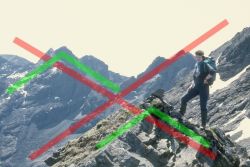 Consider this final image,
look at the red cross shown, formed by the mountains and cairn. Consider this final image,
look at the red cross shown, formed by the mountains and cairn.
The general principle here is that there is a pleasure in order and symmetry,
even if this symmetry is made up of logically unconnected parts of the picture.
They do however help lead you between the different parts of the picture. You
can take this even further and try to echo the shape in the foreground (the
cairn), with the shape in the background (the mountain in the top left hot-spot)
which is highlighted in green. With KAP there is less of a concept of foreground and background,
however the concept of echoing shapes from different parts of the image still
applies.
Sun, Shade, and Impossible Angles
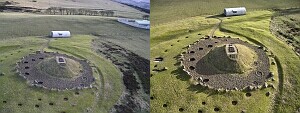 The sun is the KAPers best friend, it accentuates height through casting
shadows, and offering shading on vertical surfaces. The two shots shown have not
been changed in any "photo package". They were taken less than 60
seconds apart, on a day where the sun came and went quickly. Try to ignore the better framing of the "sunny" shot,
and note it's improved contrast and the 3D property that the strong
winter shadow gives it. Try to keep the whole shadow
in the frame, and if possible use the morning or evening light for long shadows
and richer colours as shown here. Don't be frightened to shoot with the sun at 90o
to the camera. With the more interesting angles directly into the sun it's
difficult to control exposure. The use of gray graduated and polarising filters
is even more unobtainable, c'est la vie. The sun is the KAPers best friend, it accentuates height through casting
shadows, and offering shading on vertical surfaces. The two shots shown have not
been changed in any "photo package". They were taken less than 60
seconds apart, on a day where the sun came and went quickly. Try to ignore the better framing of the "sunny" shot,
and note it's improved contrast and the 3D property that the strong
winter shadow gives it. Try to keep the whole shadow
in the frame, and if possible use the morning or evening light for long shadows
and richer colours as shown here. Don't be frightened to shoot with the sun at 90o
to the camera. With the more interesting angles directly into the sun it's
difficult to control exposure. The use of gray graduated and polarising filters
is even more unobtainable, c'est la vie.
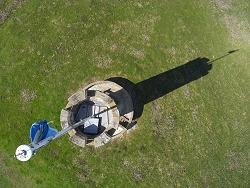 Make
the most of what KAP does best - occupy the space between conventional
photography and high altitude aerial photography. Make
the most of what KAP does best - occupy the space between conventional
photography and high altitude aerial photography.
The image on the right was taken perilously close to the tower, hence the
perspective. A huge flag set against the slender shadow, which is slightly exaggerated
by the ground falling away to the right - note the shadow of the top of the
tower is in shot. Again, it's a general photography rule that you shouldn't cut
shadows off the edge of the frame.
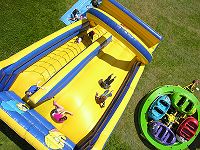 Take advantage of the incomprehensible human ability to recognise objects
from above, and toy with the viewer. Note that horizontal close-ups of this
tower don't work on their own, they could just be part of a bigger castle's
ramparts. Show enough of a building to set it in context and set the camera's
position in an unattainable space. If however you are working on a montage, then
these shots can be used once the viewer has had the context set by other shots. Take advantage of the incomprehensible human ability to recognise objects
from above, and toy with the viewer. Note that horizontal close-ups of this
tower don't work on their own, they could just be part of a bigger castle's
ramparts. Show enough of a building to set it in context and set the camera's
position in an unattainable space. If however you are working on a montage, then
these shots can be used once the viewer has had the context set by other shots.
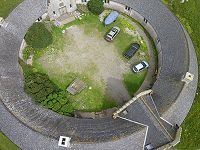 A theme that works
well with KAP is circles. KAP allows the roundness of the cairn,
the tower, and the house, shown here to be brought out in a way that is very
difficult from the ground. Play to the strengths offered by the technique! A theme that works
well with KAP is circles. KAP allows the roundness of the cairn,
the tower, and the house, shown here to be brought out in a way that is very
difficult from the ground. Play to the strengths offered by the technique!
Whilst talking about impossible angles, a word about the horizon. Keeping it flat is
difficult, but this can make all the difference. Although the horizon can be
re-set in the computer, gross errors result in severe loss as the picture is
cropped back to square. With the horizon in shot, try not to
break it with an occasional tree or building unless they are on the horizon.
Even images without the horizon
visible there are no excuses, try to keep verticals vertical, unless the content
of the picture is abstract and there is no natural sense of "up", e.g.
the image is looking straight down.
Virtual Reality Considerations
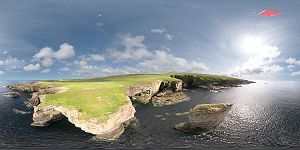 A
few words on the special requirements of virtual reality, or 360° Panoramas. If
you haven't seen these you should view ground
examples and aerial examples first. The raw
material for these VR shots is shown left. This image covers 360° from left to
right and 180° from top to bottom. A
few words on the special requirements of virtual reality, or 360° Panoramas. If
you haven't seen these you should view ground
examples and aerial examples first. The raw
material for these VR shots is shown left. This image covers 360° from left to
right and 180° from top to bottom.
Despite the huge distortion the basic image shown can be pleasing in itself.
The image has a large amount of distortion at the top and bottom so subjects
where this distortion is not obvious are often better.
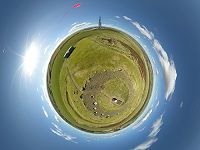 Further manipulation of
the image can produce increasingly artistic results. This view of Cairnpapple
Prehistoric Site (used in earlier examples) echoes the circular themes in the image with the circular shape
of the "world". A person entering the prehistoric mound via a ladder
is wearing a red top, counter poses the red kite flying in the sky above. Further manipulation of
the image can produce increasingly artistic results. This view of Cairnpapple
Prehistoric Site (used in earlier examples) echoes the circular themes in the image with the circular shape
of the "world". A person entering the prehistoric mound via a ladder
is wearing a red top, counter poses the red kite flying in the sky above.
In this image the ground has effectively been transformed back into the fisheye
view, but the sky has been added, and becomes increasingly distorted at the
edges, this works best with some clouds for interest but a blue sky directly
above the camera.
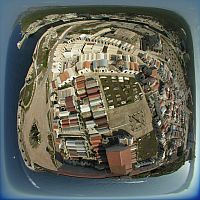 Further manipulation, can
produce interesting results. This shot has been stretched from the original
fisheye circle to a square shape - a technique that can be applied in varying
degrees, and is more suited to "square" rather than
"circular" subjects / themes. Further manipulation, can
produce interesting results. This shot has been stretched from the original
fisheye circle to a square shape - a technique that can be applied in varying
degrees, and is more suited to "square" rather than
"circular" subjects / themes.
For some, these images (and their heavy post processing) cross the line
between photography and art - whatever that means! Using these very high field
of view fisheye lenses produces surreal images anyway, the images do not
represent the view by the naked eye anyway.
Post processing of images is all part of the KAP photography process, whether
it be producing artistic interpretations with fisheye lenses, cropping a shot
for composition, straightening a horizon, or selecting a shot from 100s taken
during a "auto" KAP flight.
Neat and Tidy
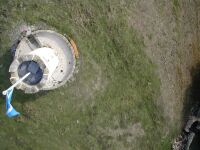 As
well as trying not to cut shadows off at the edge of the shot, try not to have
intrusions into the frame either. Keep the edges plain and simple, keep the
areas of interest within the frame. In the example here the dry stone wall and
gate bottom right is an unwelcome addition to the shot. Paths and roads can
be used to lead you into the picture, but here the gate is a distraction. As
well as trying not to cut shadows off at the edge of the shot, try not to have
intrusions into the frame either. Keep the edges plain and simple, keep the
areas of interest within the frame. In the example here the dry stone wall and
gate bottom right is an unwelcome addition to the shot. Paths and roads can
be used to lead you into the picture, but here the gate is a distraction.
Although turning the image by 180o would help the Tower shot on
the right, the shadow is missing and in the original
high resolution image you can see various KAP paraphernalia sitting on a brown
bench to the left of the steps. Try to keep the shot tidy so don't leave things
lying around! I didn't keep this image after the shoot.
This leads us on to the question of whether the photographer should be in the
picture, and what to do with the kite line if it's in shot. I have noted that
whilst the photographer's shadow in shot is normally considered unforgivable,
KAPers have a different attitude to having either the photographer / kite flyer,
or kite line in shot.
So I'd ask a question - do these things add to the image or not? The
photographer / kite flyer being in shot isn't an issue if they add some interest
or scale, normally they are far enough away to just look like another person.
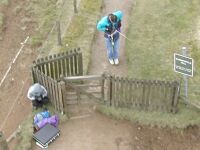 Remember
if you do think you are in shot to look up as you take the picture. As I take
the picture I'm normally squinting into the video downlink and appear as a
hunched figure (like on the left here), however there is normally enough time
to look up as you press the shutter, and look down after the picture is taken.
So the picture on the right breaks all the rules, I've called it "Like
father like son". It was the test shot at the entrance to the shoot
site, you can see the kite and KAP material as well as the operator and his son
both looking at video monitors before letting the kite rise. Remember
if you do think you are in shot to look up as you take the picture. As I take
the picture I'm normally squinting into the video downlink and appear as a
hunched figure (like on the left here), however there is normally enough time
to look up as you press the shutter, and look down after the picture is taken.
So the picture on the right breaks all the rules, I've called it "Like
father like son". It was the test shot at the entrance to the shoot
site, you can see the kite and KAP material as well as the operator and his son
both looking at video monitors before letting the kite rise.
Back to serious shots - I'm a lot less sure about the kite line being in
frame. Does it distract from the picture, or destroy the illusion of the shot?
In these cases I would electronically remove it. However if it adds to the
image, or the game of "How did they do that?" then leave it in!
So get out there and get flying, have some fun, make memorable pictures, and
remember the golden rule:
The difference between a good and bad photographer,
is that the good photographer doesn't show you his bad pictures!
|


